d'Vinci Interactive is an award-winning comprehensive learning solutions provider for corporate, government, medical, non-profit, and K-12 target markets.
Think Like a Marketer to Elevate Training
January 29, 2026

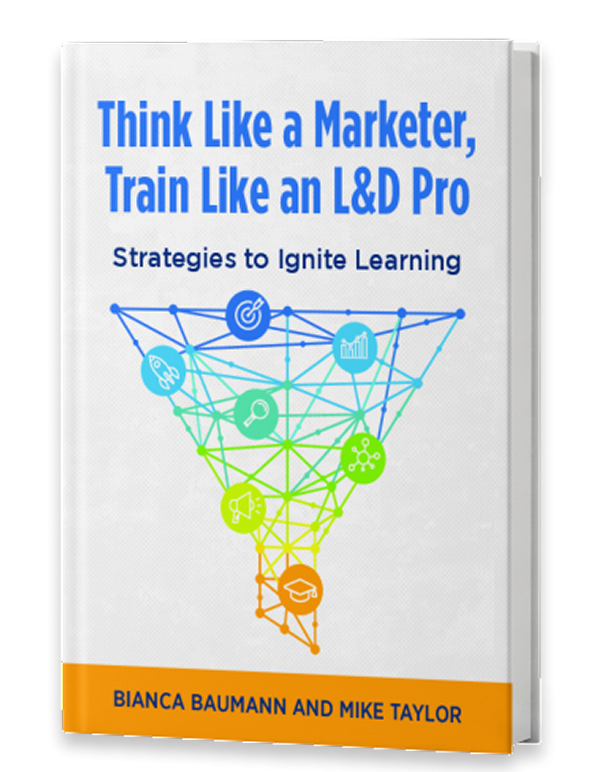
When done well, learning design grabs participants’ attention like a great marketing campaign and engages them emotionally and intellectually to make learning stick. That’s the premise of “Think Like a Marketer, Train Like an L&D Pro,” a book written by our guests, Mike Taylor and Bianca Baumann. In this episode, you will learn how to elevate traditional training approaches with marketing tools such as learner personas, journey mapping, and content strategy that come together in high impact learning campaigns.
Show Notes: Co-authors Mike Taylor and Bianca Baumann share some of the top takeaways from their book, “Think Like a Marketer, Train Like an L&D Pro,” to help you create experiences that learners crave.
- L&D can learn a lot from marketing. Marketers know the value of making an emotional connection with their audience —L&D should too. Applying marketing principles can help learning designers create experiences that boost performance and influence behavior.
- Learner personas are foundational, not optional. Understanding who learners are, what they need, and what motivates them is critical to designing content that resonates and sticks.
- Journey mapping helps deliver learning at the right moment. Mapping the learner journey allows L&D teams to support employees before, during, and after key moments—not just during formal training events.
- Content strategy drives behavior change. When personas, journey maps, and content strategy work together, learning becomes more targeted, improving proficiency and long-term behavior change.
- It all comes together in a Learning Campaign. Smaller, well-timed content—resources, nudges, and reinforcements—create more impact than one-time standalone training events.
- Success is measured beyond completion rates. True learning impact shows up in measuring performance, confidence, and on-the-job behavior—not just in LMS reports.
Learn more about Think Like a Marketer, Train Like an L&D Pro
Powered by Learning earned Awards of Distinction in the Podcast/Audio and Business Podcast categories from The Communicator Awards and a Gold and Silver Davey Award. The podcast is also named to Feedspot's Top 40 L&D podcasts and Training Industry’s Ultimate L&D Podcast Guide.
Transcript:
Susan Cort: [00:00:00] By borrowing proven ideas from marketing, L&D teams can design learning that's more personal, more engaging, and better aligned to how people actually learn.
Bianca Baumann: Once you have a good content strategy in place and you have your learner personas and you have the journey mapping, so all these three tools, the pieces together, you can really start sending the right content at the right time.
And if we do that, that is what helps us improve, uh, you know the proficiency and hopefully the behavior change in the long run.
Susan Cort: That's Bianca Baumann, co-author of the new book. Think Like A Marketer, Train Like an L&D Pro. She and co-author Mike Taylor joined d’Vinci CEO Luke Kempski and me to inspire and motivate you to transform how you approach L&D.
Next on Powered by Learning.
Announcer: Powered by Learning is brought to you by d’Vinci Interactive. d’Vinci's approach to learning is grounded in 30 years of innovation and expertise. We use proven [00:01:00] strategies and leading technology to develop solutions that empower learners to improve quality and boost performance.
Learn more@dvinci.com.
Susan Cort: Joining me now are d’Vinci CEO Luke Kempski and our guests Mike Taylor and Bianca Baumann, the authors of the book, Think Like a Marketer, Train Like an L&D Pro. Welcome, Mike and Bianca.
Luke Kempski: Great that you could join us, Mike and Bianca.
Mike Taylor: Hello.
Bianca Baumann: Hey, great to be here.
Susan Cort: Mike and Bianca, before we get started, talk a little bit about your background and what you do for a living outside of being the authors of this book so people understand, uh, where you're coming from.
Mike, let's start with you.
Mike Taylor: Yeah, so I, I've been in and around learning and workplace training stuff for, gosh, 20 some odd years, like too many to count. Uh, I've spent some time in as the proverbial, you know, one-man training team. I've been in larger teams. I spent a couple years as an Articulate community manager for a couple of years.
Uh, I've been in the agency [00:02:00] side of things and for the past four years. or five. I work at Nationwide Insurance here in Columbus, Ohio in a cybersecurity group, and I also teach in Franklin University's, uh, graduate program for instructional design and performance technology.
Susan Cort: And write a book in your spare time.
Mike Taylor: In our spare time, right?
Susan Cort: Yeah. Bianca, how about you?
Bianca Baumann: Yes, I am the VP of Learning Solutions and Innovation at Ardent right now. And uh, before that I had a lot of different jobs in the industry. I'm one of the people that actually decided I wanna do this for a living, so I'm not the Accidental, uh, learning and development professional.
Nothing wrong with that of course, but, uh, yeah, I went to university for this and I've been in this all my professional life and I've been in finance and event management and marketing where the law for marketing and learning kind of, um, came to be. And, uh, I [00:03:00] also teach at OISE, which is part of the University of Toronto here.
And, uh, it's a certificate in learning experience design. And when I don't write books and work, uh, I do love to cycle. I'm a road cyclist, uh, and I'm just getting into cross-country skiing because, you know, there's no cycling and winter here in Toronto.
Susan Cort: That's wonderful. And, and before we start talking about your book, how did the two of you come to partner to work on this together?
Mike Taylor: Yeah, so gosh, 2017 we did an online conference through the Learning Guild that was around marketing and learning. And so we both had a session and then we were both on a closing panel. And I think, I won't speak for Bianca, she can correct me if I'm wrong here, but I think we both sort of saw what each other were talking about.
Hadn't really heard anybody else doing that and you know, sort of set off a big light bulb about, you know, hey, maybe we should sort of look for ways to team up. 'cause I think we have a [00:04:00] similar viewpoint on the topic.
Susan Cort: Well, we're glad you did and we're glad that you're joining us today.
Luke Kempski: Uh, yeah, that's excellent.
I know, um, you know, somebody who's spent my whole career leading a learning solutions company and an integrated marketing agency. When I was, I don't know what I was scrolling by and I, your title of your book caught my eye and I was immediately engaged and went on, got a Kindle copy, started reading, uh, and it really connected.
And I thought, oh, we have to have you as guests on Powered by Learning for sure. Um, so you, you talked a little bit about how you came together. Um, I guess talk a little about kind of what the inspiration for the book was kind of the primary thesis of it.
Mike Taylor: Yeah. So, um, both, both Bianca and I spent time in marketing companies and marketing environment and, you know, for me the big light bulb was marketers and training people, we really have the same two big ideas or goals, right? So we're trying to get people's [00:05:00] attention because if we don't do that, nothing else matters. And we're trying to, to influence their behavior. And the, you know, the contrast between the two approaches of those two fields is pretty stark and oftentimes.
Uh, as the point of the book is, is, you know, marketers tend to do a lot of this stuff a lot better than training people. And so that was, that was kind of the seed of, of everything else that followed.
Bianca Baumann: Yeah, and for me, I was, uh, I was actually teaching marketers how to be better marketers. Uh, it was part best practices, but part, uh, a platform.
I was working at that, uh, company at the time is now part of Oracle and as Michael just saying, I realized how much overlap there is and um, I wanted to dig deeper and, and learn more. And, uh, yeah, that's really what it started, all started with some blogging and figuring out the messaging like any good marketer would.
And uh, yeah, eventually, as Mike was already telling you guys, that's when we crossed paths.
Luke Kempski: Yeah, [00:06:00] that you really talk a lot about targeting your audience or really getting to know your audience at a different level and thinking about like delineating between intuitive thinking and deliberative thinking, and I kind of think about that as, you know, trying to get to the learner's heart, trying to get to their mind, right?
The marketers often go for the heart with that emotional connection, and the instructional designers wanna get right into the brain. Give us your viewpoint on that and what you try to communicate in the book to inspire instructional designers to kind of think about it differently.
Mike Taylor: Yeah, I think that's one of the, one of the, the big foundational sort of unlocks in this is book is kind of highlighting the fact that our brains are like really amazingly fantastic at filtering things out.
And, and a lot of that's happening automatically and, and subconsciously and marketers are really good at a understanding that and B, navigating it. And so, you know, first job for a [00:07:00] good learning designer. And I don't think this really, that I've seen anywhere really gets talked about a lot. It's like, um, designing for attention and a lot of people sort of assume what's in the LMS and it's a compliance thing, so therefore the attention is guaranteed, which, you know, we know is not really true.
You know, a lot of people design for this sort of calm, logical, focused audience that doesn't really exist or rarely exist. And so, you know understanding, you know, what are those sort of hardwired things that our brain will set up and pay attention to? You know, how can we earn their attention because we don't automatically have it, you know, and that's that fast automatic part of our brain system.
One like Daniel Kahneman's book sort of popularized. Uh, and you know, if we can't get that system one attention, we can never get any further. So if we don't get attention, it could be the best thing in the world. It doesn't make a difference. So we have to get that attention first, and then once we've [00:08:00] hooked them with the attention, then we can go to the deliberate side and, and use those two things together.
Luke Kempski: Yeah, that's great. I, uh, I love that in how, in the book you have the workshop shop type activities at the end of each chapter. Um, that gives really a chance for, uh, the reader to actually apply thinking like a marketer to, to what they're doing. I guess. Have you ever, um, used those activities in, in workshop settings and how do, how do the learners in those settings respond to those activities and any antidotes that you might have?
Mike Taylor: Yeah, so we've done a, um, quite, quite a few workshops and conference presentations and stuff like that. And I think, you know, one of the common arcs of that experience is, um, we, we will sort of prompt them with something maybe they hadn't thought of before. And there's, there's typically sort of a brief pause and then.
You can almost see it happen. There's like the big light bulb moment. And I, I think you know, what it [00:09:00] does is it surfaces some assumptions that people didn't even realize they're making. So a lot of us are on autopilot and then somebody mentions a thing that you hadn't thought of, and you know, that's the light bulb moment.
Um, you know, one of the, one of the really good examples I think that kind of illustrates that is in the, in one of our workshops we have people, we give them some really boring. Traditional compliance training topics, then we ask them to rethink that and use some headline analyzing tools. Uh, these tools give them a score.
So it's kind of like who can get the highest score? And in the process, they're learning what makes good titles. There's a couple of tools, um, from share through and Co-Schedule that are really great. And it's one of those things where. I was guilty of this. I talk about it in the book of just in, you just give the logical, factual title and you never think of it again.
But it's really, as you probably know, you know, titles and subject lines are super, super important. It's [00:10:00] this little detail, it's like the gate to get into that attention zone, and it shapes everything that comes after that, or nothing comes after that. And so it's, it's really much more. Important and worth consideration than I think most training people realize.
Luke Kempski: Yeah. Just like your title grabbed my attention scrolling by. Yeah. Anything to add about that, uh, to that Bianca?
Bianca Baumann: Yeah, I just wanted to say that these are not just exercises for workshops, so I, I wanna make sure that everyone knows when you read the book, you can actually take those activities in your day-to-day work.
And for us, that was really, really important when we wrote this book, that it's something actionable that people can do the next day quickly. Easily, ideally at low cost or no cost. And, uh, yeah, a lot of those activities are things we do every day. Uh, you know, a lot of the, the more strategic chapters, those are things I use with, with my consulting clients.[00:11:00]
Uh, and they work.
Luke Kempski: Yes, no doubt. I know that, um, over the years, our environment, which again includes marketing agency and learning solutions company kind of side by side. That they've kind, they've cross pollinated over the years, and I know on the learning side, the instructional designers have adopted things like creative briefs and personas and learner learning journeys, learning maps, um, in our experience design work.
I guess, um, talk about some of those tools and how valuable they can be in the instructional design process.
Bianca Baumann: Yeah. I'm a, I'm a big fan and believer of learner personas, which really are built on the user personas in marketing, and they should always be the. First step of our design. It's not, you know, this checkbox, which I've seen many times as well, but really it is, it goes above and beyond our target audience analysis.
So instead of just looking at what's their job role, how long have they been with us? And I, I don't know what we usually cover there, [00:12:00] but, um, it's really just some additional information that goes much deeper into that emotional level of how these people feel or really motivates them. And this way I can get a much more focused training program or learning program for these people, uh, because it's much more personalized.
Um, learning personas will never get us all of the learners individually. And you know, we all have very, very individual experiences. But they get us much, much closer. And I always like to think about it from, you know, the emotions, what's going on, what drives them, and then understanding their motivations and where emotion and motivation cross, that's what behavior change is happening.
And that's what we do every day, right? We're trying to, to change behaviors. So yeah, I feel it's a, it's a very important tool to have about three to five learner personas to get started to really help you better understand your audience. And then from there. You can use journey mapping to really [00:13:00] lay out what each of the learner journeys for these learner personas, uh, look like, look like from point A to point B.
Luke Kempski: Yeah, absolutely. Um, another area that you, uh, there's a whole chapter dedicated to in the book is content strategy. We also, uh, see a lot of cross pollination between the marketers and the learning designers there. Um, you know, it seems like learning designers kind of have a natural ability at being content strategists.
It kind of is a, a natural evolution of the, their skills and talents. But with like learners today, you know, looking for the fastest knowledge solution or skill solution, which is often what Chat GPT or Gemini or just a Google search or YouTube, uh. I guess, you know, talk about how learning designers, learning experience designers can, um, take content strategy and make it so that it's at the right place and the right time for learners to use it.
Really [00:14:00] prepare them to improve performance in their job.
Bianca Baumann: Yeah. It's interesting when you said that you, you feel that learner learning designers often have, you know that that ability to be good content strategists. I usually don't see that. Uh, so,
Susan Cort: But at d’Vinci, they are!
Bianca Baumann: That's wonderful.
That's wonderful. And, and, and maybe it's also just the terminology, um, element here. So when we talk about content strategies, it's really around how do you organize your content before you create training out of that content. And I think that. First bit is sometimes, you know, rushed or overlooked. And you know, I, I say this because often in our workshops and sessions, what does content mean to you?
And people say e-learning modules, videos. Well, that's the finished training, but the content is actually the written words that go into that, right? And so. Um, I think what, what we could do [00:15:00] better in learning and development. I'm happy you guys to hear you guys are doing this already, is really how do we organize the content upfront in, in usable containers if you want.
So, so then I just have the written word and then from there I can really get into that content strategy. Repurposing content, for example, right? So I have the written word over here. Now I wanna create a video. I wanna create a blog post. I wanna create an e-learning module, an ILT, whatever it might be.
But it's based on that source content, right? Um, for us, content strategy also means. Um, uh, crowdsource content. So let's get off our soapbox and see who else is in the, uh, in the organization that can actually help us create more content. And curation is a big piece of that too, right? There's a lot of great content out there already.
What can I borrow and actually tie into, into what, what we're doing? But, um, yeah, big fan of content strategy and I, yeah, I wish most organizations would be a little [00:16:00] bit more organized. Before they start jumping into designing actual solutions?
Luke Kempski: Yeah, well certainly, um, reflect back on how they're consuming learning themselves.
They will know that it's not from just one particular, uh, medium, if you will, or, or channel, uh, and that as learning experience designers, we have to think about multiple channels and also playing out. Time in addition to different channels.
Bianca Baumann: Absolutely. And then Luke, uh, apologize, I forgot to answer the last part of your, your question, which you were just alluding, alluding to, that, uh, you know, once you have a good content strategy in place and you have your learner personas and you have the journal mapping, so all these three tools, the pieces together, you can really start sending the right content at the right time.
And if we do that, that is what helps us improve, uh, you know, the, the proficiency and hopefully the behavior change in the long run.
Luke Kempski: Yeah, absolutely. I know in, um, marketing, and maybe Mike, you wanna [00:17:00] comment on this, uh, we always make sure that our marketing materials, our marketing, um, efforts, clear call to action, and, and you talk about that as something to you can embed in your training and your, um, your learning objects, if you will.
Talk a little bit about that. Is this something we should be really thinking about as learning experience designers to have calls to action in our materials?
Mike Taylor: Yeah, I think absolutely. And I think this is another one of those things that. Uh, it's not in, you know, any instructional design training programs.
Uh, it's one of those things where once you set the light bulb off, you know, it's a super simple thing to start doing and thinking about, but has, has a big impact. I, I, I mean, I can tell you, gosh, I don't know if I've ever seen. Personally, you know, uh, an e-learning course that I had to take. You get to the ending screen, maybe they give you a quiz.
And the last thing, what does it say? It says close a window or exit course, right? [00:18:00] Like it's a wasted opportunity of point is, you know, what do you want people to do about that? So by not using a call to action, we're just sort of. Hoping that they can figure out what we want them to do and apply it. And, you know, as we know, hope's not really a good strategy.
Usually it doesn't work out too good. And so it's, it's uh, you know, some behavioral science stuff, some marketing stuff, you know, there's the, the key point here is, is people are much more likely to follow through. And if you can give them a small, specific targeted action, you know, what's the next step? So if you go tie that back to the content strategy.
In marketing technology, you know, we could see that somebody completed a course and then maybe we could send them a reminder in teams to give them a call to action. And so when you start to look at these things differently, gosh, there's just a whole world of things and possibilities that that open up.
And you know, the key thing is if you're new to this stuff, you know, call to [00:19:00] action is not click next. It's like, what's the behavior? You're, you're trying to get people to do that's tied to a real scenario, easy for them to understand, to do. Ideally you would reinforce that again, kind of campaign thinking over time.
Again, like virtually everything in the, in the book, right? It's totally free. It doesn't cost you anything to start sort of adding call to actions. And, uh, once you have that light bulb set off, you can just start doing that everywhere.
Luke Kempski: Yeah. You mentioned, um, bringing it all together. I guess you used the word campaign when you were talking.
It feels like in the book that those early sections of the book kind of build to the point of, okay, now let's think about it as a campaign and pull all together the tools. Mm-hmm. The content strategy, the audience analysis, uh, it, so I guess talk a little about how, what, what's the difference in an instructional designer's thinking when they approach things or approach?
A learning [00:20:00] objective that they're trying to achieve with our audience as a campaign.
Bianca Baumann: Yeah, it really starts, you know, I loved how you summarized this and, and you clearly, uh, see the structure in the book, right? So yeah, it's all the pieces that they come together in the learning campaign, but the difference is that we don't think of a learning object, as you call it, as a one-time event, but it's like an ongoing journey.
Right. And you mentioned earlier already there's multiple channels as well. So channels being, uh, you know, it could be our LMS. It could be YouTube, it could be the internet, it could be Slack or teams, right? And what we really wanna do is that we have these multiple touch points. So we identify what does it take to change behavior.
What does it take to go from point A to point B and all the steps in between? And then for each of those milestones, we actually design a piece of training. And yes, it's a little bit more work than if we just do the one-offs, but going back to the content [00:21:00] strategy piece, you can repurpose content. So it doesn't mean you have to recreate everything, you just have to recreate a small portion of it.
And yeah, along the way, you can measure. If you're actually meeting your learning and performance objectives that then hopefully, you know, feed into an overall business goal, which should, a campaign should be driven by an overall business goal, not just by pure learning and performance objectives. And I think that's another big difference between, you know, thinking more traditionally versus, uh, thinking as a market.
Susan Cort: That's gotta have an impact on the learner too. I mean, thinking of all of us as learners, of course, you know, if you think that you're, you're being trained on something that is part of a larger mission, part of your company or your organization's mission, it will feel more intentional, more purposeful. I mean, doesn't that impact the learner's ability to kind stick with it and, and, and feel like it's a, a valuable use of their time?
Bianca Baumann: Absolutely. I mean, you have to make that connection clear to everyone, right? Because we still have the personal [00:22:00] motivations that we wanna speak to, but also it's like, Hey, you know, if you are part of this, it also means you're part of that and that means X, Y, Z to your point, right? So yeah, absolutely. It's all, ideally it's all connected.
Luke Kempski: And, I know you also progress into talking about.
Important and certainly something that's, uh, widely, uh, used in both marketing and training. Uh, I do think sometimes on the training side, approach to measurement be take too long, cost too much, and kind of get in the way, making the effort to, to measure what's working and what's being consumed even. Uh, I guess are there ways that learning, uh, experience designers can think about measurement. More efficient ways, ways that, uh, don't have barriers to them implementing and actually doing it.
Bianca Baumann: I mean, traditionally, right? We finish a training [00:23:00] program and then we measure, and that's just something, you know, we really need to move away from. I just mentioned those, you know, learner journeys and, and measuring the, the learning and performance objectives at each of the milestones. So, again, taking a step back when I, you know, when someone comes to me and says, oh, we need this training.
A, I really wanna understand if you really need training, if there's a business need behind all of this. And then if there is, um, I should be able to identify what that business goal is that we're trying to achieve, increasing sales or customer satisfaction, or whatever it might be. And then I start outlining my learner journey.
And again, at each of the milestones I wanna have learning and performance objectives. If I reach those, they will feed into my overall business objectives. So I call these leading indicators, right? So along the way, throughout the journey, every step I can measure if we're on the right track. And I think that is something, a mindset shift for traditional, um, learning experience designers.
To really think about measuring [00:24:00] in the moment all the time. And it's not just the smile sheets, right? We have so much technology, uh, available to us. Um, if you use something, something like Slack or, or Teams, there's a ton of engagement data you can capture, right? Uh, we have our LMS data, but yeah, also observations where we can.
And so yeah, there's just a whole bunch of different metrics that we should look at and not just completion. I think we're way past just looking at completions because that doesn't help us measure behavior. And again, I think if we tie everything we do better to business outcomes, we will also get better at measuring what we're doing.
Luke Kempski: I guess before we, um, wrap it up are, are there any next steps that you plan to take together or other programs that you plan to work on together? Other books? Uh, anything in your future in collaborating, uh, or what's next for your topic? Think like a marketer.
Mike Taylor: Yeah, so, so I, I think the, the, the big thing is, [00:25:00] you know, just kind of spreading the word and getting people educated and informed and, you know, show them some of these easy ways that they can adopt. And like we mentioned, you know, for free, it's just, just the mindset. Um, you know, the other thing I haven't even, I don't if I've even really told Bianca this. It's, it's really encouraging how much. Most, if not all of this stuff that we put into the book, how well it lines up with learning science and cognitive psychology.
We talk about campaigns and space learning and, and all of this stuff. And it just really reinforces the, the, the connections between those two fields. Um. So, you know that maybe there's another book in there. I don't know. I think probably it's, it's too soon, but, but, uh, I never thought I would write the first one, so I'll, I, I'll not say, I'll never write a second one.
Bianca Baumann: Yeah. To Mike's point, I think just continuing what we're doing right now, I think, you know, last year after the book came out, we really focused on those first couple of chapters in our sessions and [00:26:00] webinars and conferences and whatnot. And I think this year we're shifting to a couple of new chapters to really build that out even more and, and talk about it more.
And I mean, there's so many chapters in the book, uh, you know, there's, there's tons of opportunities to, to try different messaging with different people there as well. And, um, and then, yeah, we'll see, we'll see where, where that takes us.
Luke Kempski: Yeah, no, I often, um, think about marketing and learning where they intersect.
One is, uh, you know, we have to market our training, our learning offerings in many cases, both internally and even sometimes externally. And then you also see situations now where, um, customer education is a, is a, is a business area within an organization, particularly in the, in the B2B world. Some of our clients do that where, um, you know, they're training.
It has a roofing product, for instance, and they train the appliers of that roofing product, and it's a really key, um, way to market their products, but also, [00:27:00] uh, is another avenue for them to generate revenue and income for their organization. So, um, and it certainly benefits the people in that value chain.
To both think like a marketer and to think like an educator. So I, have you had any experiences or feedback from people in those different roles?
Bianca Baumann: So, funny you bring this up because my first two roles were in customer education. Before customer education was a, was a thing, you know? And so, um, at the time I was actually talking about it quite a bit and it just.
Kind of fell on deaf ears and, uh, should have stuck with it. But, uh, you know, I shifted into the marketing and learning piece, which is still, to your point, very closely, um, related. But I mean, for me, it's a no-brainer, right? If you have a SaaS product, you should have customer education and not just customer success.
Uh, I mean, I loved your example for, you know, the, the roofers there. There's so many examples of, uh, custom education, how you can really make that part of [00:28:00] your. Of your buying process and, and, and, you know, advocacy and, and loyalty. I mean, there's like a million angles to this. Um, yeah. I mean, but I, I'm glad to finally see it, um, picking up
Mike Taylor: and I, I can, you know, add that even in sort of a quote unquote, boring topic like cybersecurity. Uh, our, our view is, you know, we're not the department of no and trying to say everybody's bad and don't do this and don't do that. We're actually sort of flipping the other side of the coin and, you know, our entire purpose is if we do this well, it's, it's a competitive advantage and we've actually.
Done a pretty good job with that and have now been invited into sales calls and sales meeting with funds that are looking to invest billions of dollars. And so they can look at us and say, this is, this is a well run, secure place. Then it's just, you know, a competitive advantage that has a huge business impact.
Luke Kempski: Yeah, that's, it's exactly right and, uh, such an exciting time, I think with your book coming out [00:29:00] in 2025 and Karl Kapp’s book “Action First Learning,” it's really a banner year for instructional design learning experience design books that if I, no, if I were teaching a class here in 2026, I would want both of those books for my students to go through and hopefully they're influencing a lot of the work being done right now and into the future.
Um, so thank you for writing the book. It's really great and congratulations on it and I look forward to hearing about what's next.
Mike Taylor: Yeah. Thank you. Good company to be in.
Biance Baumann: Yeah. Thank you.
Susan Cort: Thank you both very much. This was inspirational. I think our listeners are going to be reframing what they do and thinking like marketers, so thanks for taking the time to talk with us on Powered by Learning.
Mike Taylor: Thank you.
Susan Cort: My thanks to d’Vinci CEO Luke Kempski, and our guests, Mike Taylor and Bianca Baumann, authors of Think Like A Marketer, Train Like an L&D Pro. If you have suggestions for a topic or guest, please reach out to us at Powered by Learning at dvinci.com. And [00:30:00] don't forget that you can subscribe to Powered By Learning wherever you listen to your podcasts.
Ready to Connect?
Contact us today to start the conversation. We work with you to find innovative solutions that drive a sense of shared accomplishment and trust.